SEO case study · Site migration · Vestis
Rebranding without the brand.
When Aramark spun off its uniforms business as Vestis, the new company got the customers, the locations and the website. It didn’t get the name people typed into Google.
- Client
- Vestis (formerly Aramark Uniform Services), via Amdocs Studios
- Role
- Content Strategist
- Timeline
- October 2023 – February 2024 launch
- Scope
- Domain migration · Rebrand · Information architecture · Content · Local SEO
- Tools
- Screaming Frog · Ahrefs · Google Search Console · Google Analytics · Microsoft Excel · Google Business Profile (+ APIs for bulk uploads)
-
1
brand name and domain retired
-
~40
new non-branded content pieces
-
~350
local landing pages + listings
-
2x
redirect checks: staging, then production
01 · The situation
A new company with an old search habit.
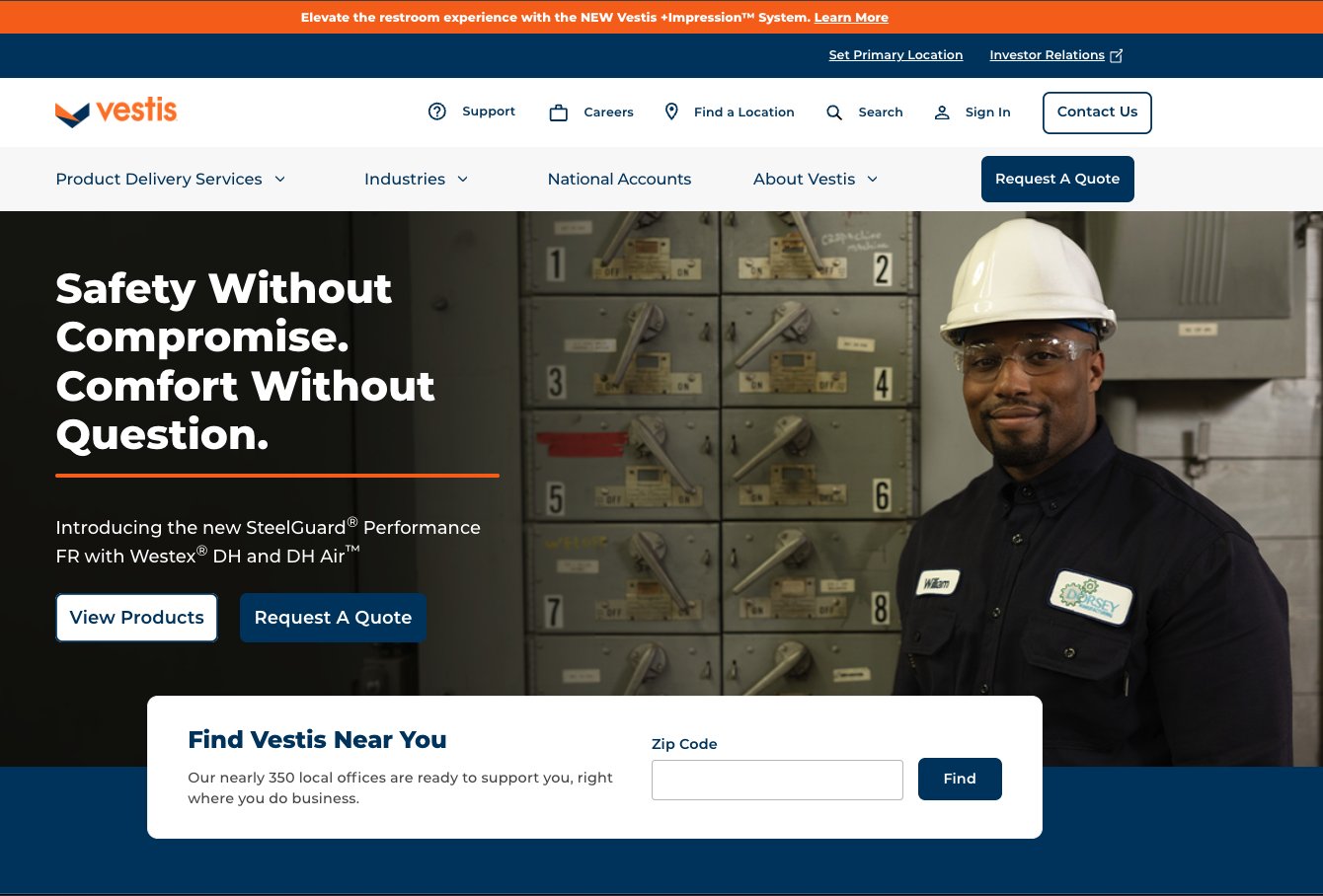
In 2023, Aramark spun off its uniforms and workplace supplies business as a separate public company called Vestis. It got a new name, a new logo and a new domain. The old uniforms site had years of search history behind it. A big share of its organic traffic (visits from unpaid search results) came from people searching for the Aramark name.
That name was staying with Aramark. The site had to move to Vestis and leave the name behind.
02 · The problem
You can redirect a URL. You can’t redirect a habit.
A 301 redirect tells Google a page has moved for good, and it passes most of the old page’s ranking signals to the new one. That takes care of the pages. It does nothing for everyone who keeps typing “Aramark uniforms” into a search bar.
Some loss was certain. The work came down to three things:
- 01
Size it
Know how big the loss would be before launch.
- 02
Shrink it
Protect every bit of equity the old site had earned.
- 03
Replace it
Give the new site ways to earn traffic that don’t depend on the old name.
03 · The content matrix
Every URL, scored before anything moved.
Before any work on the new site started, I crawled the old one with Screaming Frog to get a full inventory. Every URL got its own row in a spreadsheet, scored on:
- Organic & direct trafficHow many people reached the page from search, or by going straight to it.
- Keyword portfolioWhich searches it ranked for, and how many of those included the Aramark name.
- Backlink portfolioWhich other sites linked to it, a big part of how Google judges authority.
The matrix did two jobs. It showed which pages mattered most, so they were mapped and protected first. It also showed how much of the site’s traffic depended on the Aramark name, and that’s where the forecast came from.
I used the same approach, with leads added as a metric, on the Wasabi replatform.
04 · Forecast & expectations
Tell people about the drop before it happens.
Using the matrix, I estimated how much branded search traffic the new domain would lose. Then I walked stakeholders through that forecast before launch. Nobody likes hearing traffic will go down. They like it a lot less when it’s a surprise.
The goal: make the post-launch conversation “is this tracking to plan?” instead of “what went wrong?”
05 · Information architecture
Build the new house before you move the furniture.
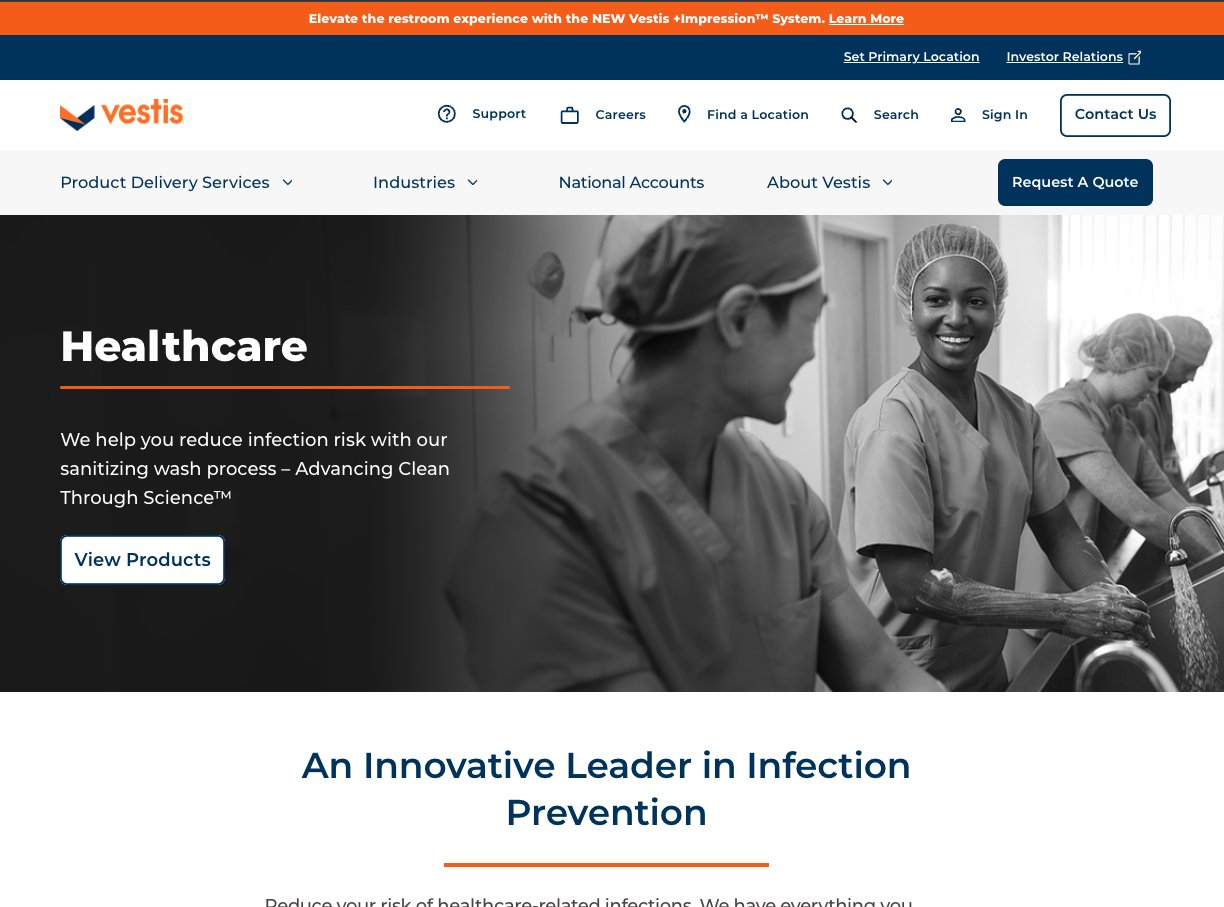
The migration was a chance to fix the structure, not just copy it to a new domain. Before mapping a single redirect, I designed a new information architecture for Vestis: how pages are grouped, how they link to each other, and how someone gets from a broad topic to the exact service they need.
The site was organized two ways: by product delivery service, and by industry. A restaurant manager and a facilities buyer can each start from the path that fits how they think and still reach the same pages.
Path 1 · Product delivery services
- Uniforms
- Floor mats
- Restroom supplies
- First aid & safety
- Towels
- Linens
- Mops
Path 2 · Industries
- Automotive
- Food processing
- Food service
- Healthcare
- Manufacturing
- Cleanroom
Categories as they appear in the vestis.com navigation today.
Settling the structure first meant every later decision had a place to land. New content had a home, and every redirect had a clear destination.
06 · New content clusters
Traffic that doesn’t need the old name.
Branded search was going to shrink no matter what. So the long-term fix was to earn traffic from people who had never heard of Aramark or Vestis, but were searching for what the company actually does.
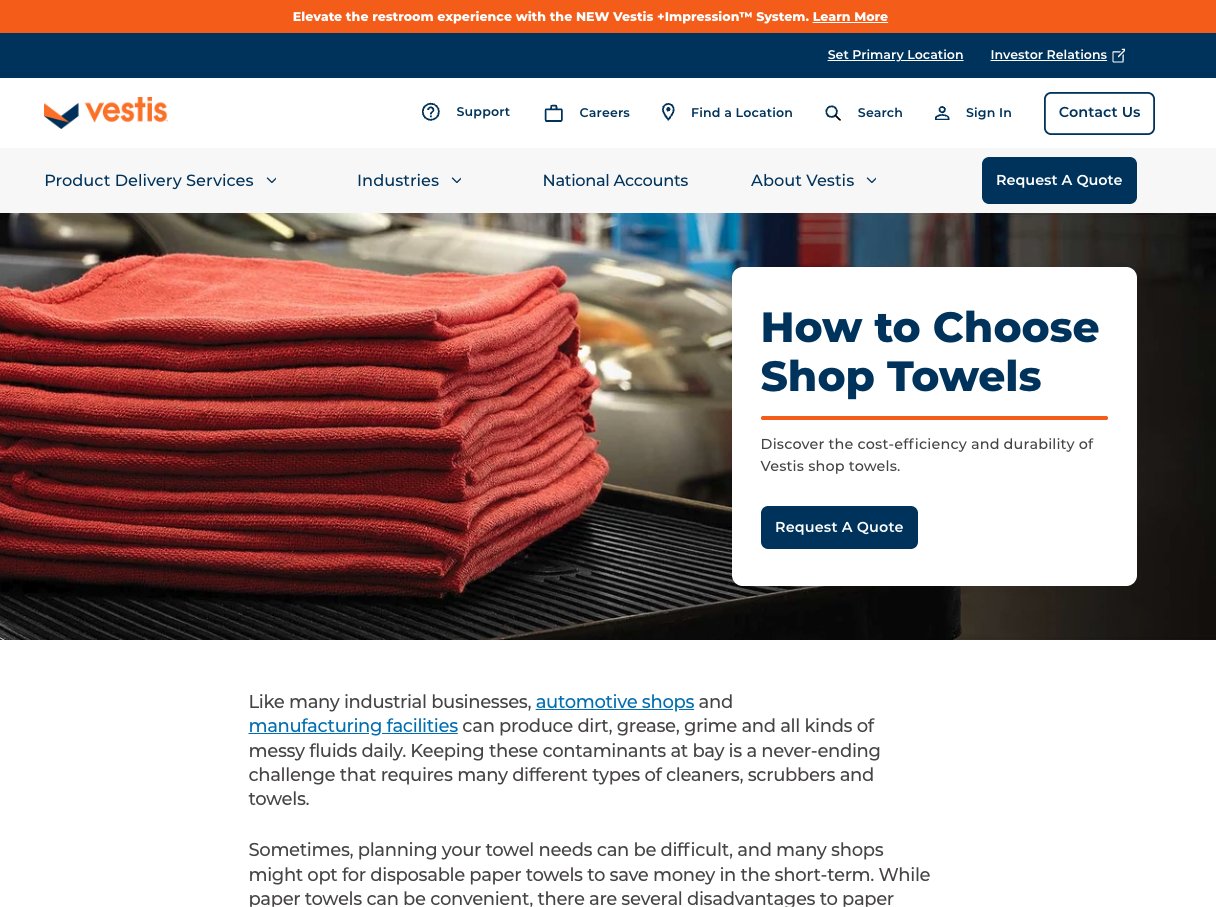
I ran non-branded keyword research to find those searches. That turned into about 40 new pieces of content, grouped into topic clusters. A cluster is a main page on a subject, with supporting pages around it that all link together, which helps search engines see the site as an authority on that topic.
Every cluster was built into the new IA, not bolted on afterward. The clusters went live with the new site in February 2024.
07 · Redirects & on-page alignment
Every old URL, one clear destination.
With the structure and content in place, I mapped the old site onto the new one. Two kinds of redirects did the work:
Pattern redirects
Covered the bulk of the site, where whole groups of URLs moved the same way.
Hand-picked 1:1 matches
The matrix’s top pages, by traffic, rankings and backlinks, each got the closest possible match on the new site.
A redirect only works if the destination deserves it. A page that ranked for a specific search had to land on a page that answered the same search. So on-page alignment ran alongside the mapping: titles, headings and content on each priority destination were adjusted to match what the old page had earned rankings for.
08 · Local SEO
Nearly 350 locations, one new name.
Vestis serves customers from physical locations, and a lot of local searches never reach a website. People see the listing in Google or Bing and call or get directions from there. Those listings still carried the old brand.
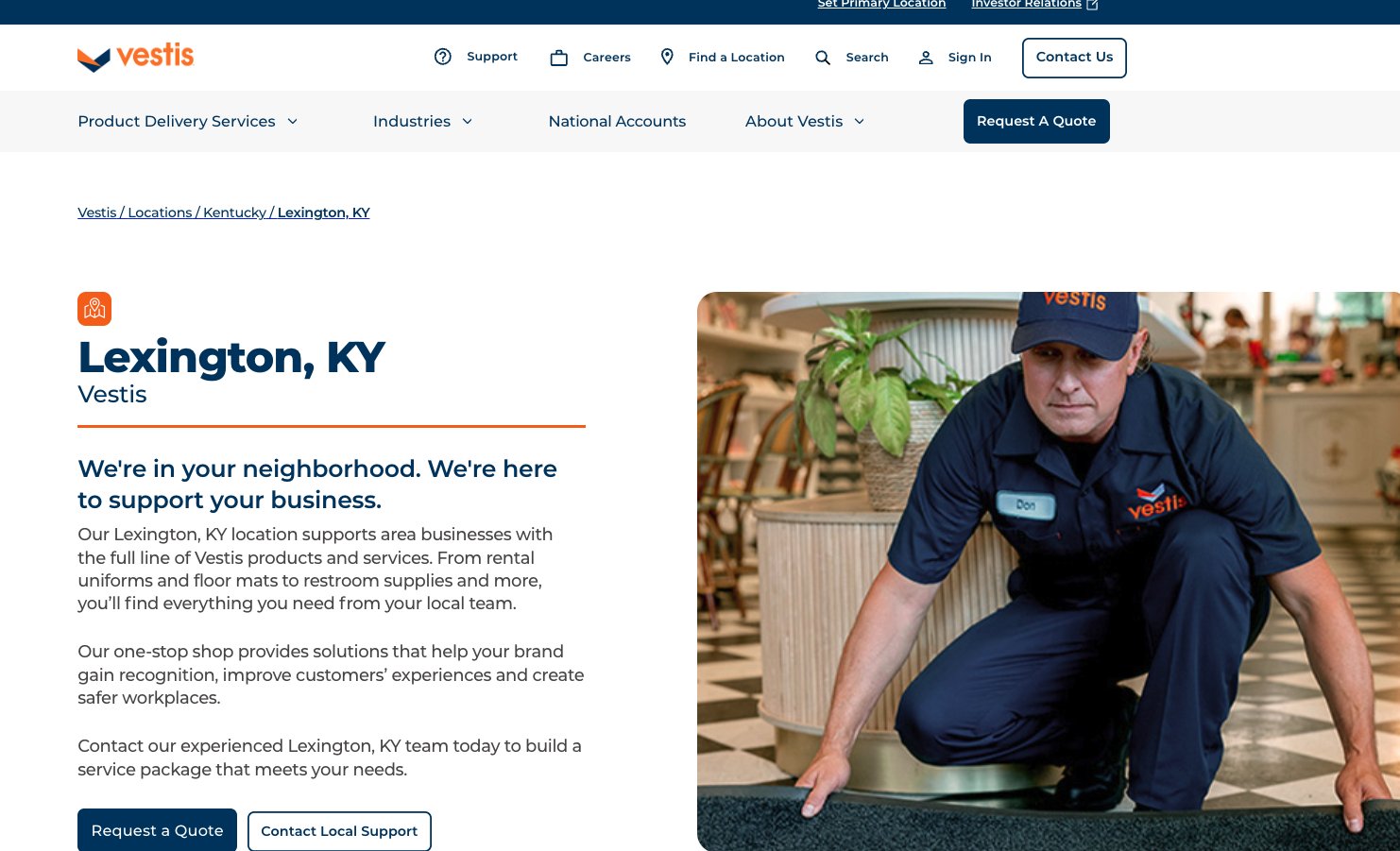
We built nearly 350 unique landing pages, each optimized for its local market, and paired every one with an updated Google Business Profile and Bing Places listing. The content was generated programmatically, which is the only realistic way to do 350 pages well without spending a year on it. Local search showed Vestis, with accurate details, where people were already looking.
- Locations
- State
- City landing page + GBP + Bing Places
09 · Post-launch QA
Check it in staging. Then check it again.
Every redirect was tested in a staging environment before launch. Then we tested them all again in production. Staging is a rehearsal, and plenty of things work in rehearsal and break on opening night. We confirmed every 301 was in place on the live site.
After launch, I monitored traffic against the forecast and coordinated the old and new Google Search Console properties, so Google had a clear picture of where everything had moved.
10 · After launch: Core Web Vitals
The scores weren’t the problem. They were a symptom of worry.
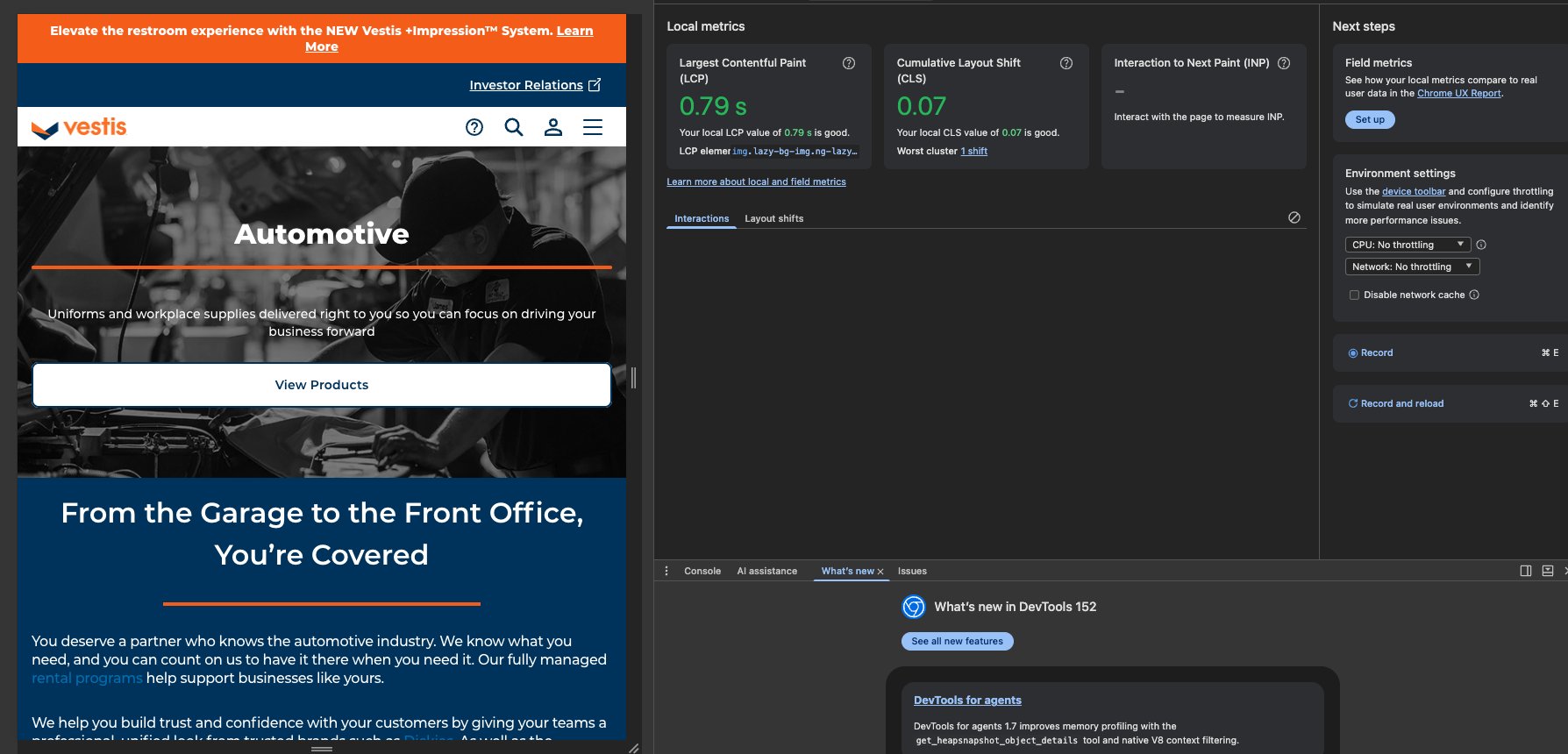
Core Web Vitals are Google’s measures of how fast a page loads, how quickly it responds, and how much it jumps around while loading. After launch, the new site’s scores sat in the “needs improvement” range. With branded traffic down as forecast, the client was anxious and wanted everything green.
There were real fixes to make. I found oversized images and images that weren’t lazy-loading, meaning they loaded before anyone scrolled to them. The team found that the chat widget and heatmap tool were slowing pages down, and we optimized how they loaded.
The bigger job was keeping the focus in the right place. Core Web Vitals mostly act as a tiebreaker in rankings. The traffic dip came from retiring the Aramark domain, which the forecast had predicted. So the fixes went in, and the main effort stayed on recovery: the content, the redirects and the local pages.
11 · Learnings
What I’d keep, and what I’d change.
- 1
Score everything first
The content matrix drove every later decision: the forecast, the redirect priorities, what got rebuilt. I’d do it the same way again.
- 2
Plan for the traffic you can’t redirect
Branded search is loyalty to a name. When the name goes away, you need new reasons for people to find you. That’s why the 40 content pieces and 350 local pages mattered more than any single redirect.
- 3
Measure speed from real visitors earlier
Google’s field data runs on a rolling 28-day window, so fixes take weeks to show up. Real-user monitoring from launch day would have shown progress right away and taken some anxiety out of the room.
Related SEO case study
Wasabi: a new site that keeps the old traffic.
A WordPress to Storyblok replatform and rebrand for a cloud storage company: content catalogue, keep/kill/repurpose, a three-part IA and hreflang across six localized sites.
Read the case study →
Related SEO case study
Qm Uniforms → Galls: fold in the brand, keep the products.
An ecommerce brand consolidation: a SKU-based 1:1 redirect map for 10,000+ products, aligned categories and on-page signals carried over.
Read the case study →
Moving a site? Talk to someone who’s done it.
Rebrand, replatform or domain change, the risk is the same: years of search equity riding on a spreadsheet. Let’s make sure yours is a good one.