AI voice & explainability system · T-Mobile
NetHive IQ. One AI, three very different jobs.
NetHive IQ is T-Mobile’s national network operations platform — dashboards, incident tools, and field workflows used by executives, operations teams, and engineers standing at a cell site. As AI moved into each of those surfaces, there was no shared answer for how it should sound, when it should act on its own, and when it needed to stop and ask.
I built that answer: a Voice & Tone Style Guide, a set of AI Best Practices, and an Explainable AI (XAI) standard — one system, adapted to three jobs that have almost nothing else in common.
- Role
- Voice, tone & explainability system design
- Product
- NetHive IQ — T-Mobile’s network operations platform
- User groups
- Network Executive · Operations Team · Field Engineer
- Deliverables
- Voice & Tone Style Guide · AI Best Practices · XAI Standards
01 · Objective & personas
Same AI. Three completely different users.
A network executive needs a KPI and a decision. An operations coordinator needs enough context to act fast without getting buried. A field engineer standing at a cabinet with a multimeter needs exact numbers, not a summary. One AI layer was being built to serve all three — without a shared standard, every team building on it would invent its own voice, its own confidence language, its own judgment calls about when to act and when to defer to a person.
Network Executive
Success: Confidently steer network strategy and performance at the national level.
Needs: Professional, data-driven, concise — KPIs and recommendations, no operational noise.
Operations Team
Success: Maintain smooth, real-time network operations and service quality.
Needs: Semi-formal and collaborative — enough technical context to support coordinated action.
Field Engineer
Success: Quickly deploy, maintain, and fix network infrastructure with minimal downtime.
Needs: Direct, task-focused, highly technical — exact readings, minimal fluff.
02 · Voice & tone
Voice stays constant. Tone flexes.
The first fork most teams get wrong: treating voice and tone as the same lever. Voice is the AI’s consistent personality — confident, clear, human-centered — and it never changes. Tone is what flexes: formality, complexity, and warmth adjusting to the situation and the person in front of it. Voice is why the AI always feels like the same character. Tone is why it doesn’t sound identical talking to an executive and a field engineer mid-repair.
Core principle
T-Mobile’s voice isn’t marketing language layered on top. It’s choosing words and structures that reflect a people-first, direct, action-oriented culture in every interaction — including the highly technical ones.
Four brand voice principles, adapted to technical contexts
People-first language
Prioritize human-centered terminology even in technical contexts.
- “Team member” not “resource” or “technician”
- “We’re investigating” not “Issue is being investigated”
Reinforces that technology serves people, not the other way around.
Direct & action-oriented
Clear, imperative language that drives toward outcomes.
- Lead with action verbs: “Check,” “Review,” “Deploy,” “Monitor”
- “Check fault code” not “You might want to consider checking”
Reflects a bias toward decisive action, not corporate hedging.
Transparent & authentic
Communicate clearly and honestly, even when data is incomplete.
- “Cause not yet confirmed” not “Under investigation”
- “17 sites offline” not “Multiple sites affected”
Builds trust through honest, direct communication.
Empowering communication
Frame information to enable decisions, not just report data.
- “Latency increased 40ms — may impact real-time applications”
- “Let’s investigate the root cause” not “Investigate the root cause”
Reflects a commitment to enabling people to do their best work.
03 · The persona formula
Persona isn’t just who. It’s who, when, and what.
“Adapt to the user’s role” isn’t specific enough to implement. The full profile the AI responds to is a formula: the user group, where they are in their lifecycle with the product, and the action they’re trying to take.
Lifecycle context changes how information is framed — never the underlying voice.
New users get oriented, not advised
A first-time user and a daily user hitting the same screen need different things from the AI, even with identical voice and role. For new users, the guidance is to orient before advising — explain what a view represents before recommending anything, assume no prior familiarity, stay reassuring, and invite exploration rather than prescribing steps.
04 · Explainable AI & human-in-the-loop
Trust comes from showing the work, not just the answer.
Every AI recommendation on NetHive IQ has to show how it got there. Not a black-box output — an evidentiary chain a user can verify in seconds.
One finding, with and without the chain
Don’t
“You should issue a communiqué about the Seattle outages.”
A conclusion with no way to check it.
Do
“Seattle: 17 sites down since 08:15, affecting ~8,400 subscribers.”
Reasoning: outage duration >30 min (policy threshold met) · impact >5K subscribers (policy threshold met) · customer complaints +340% above baseline.
Recommend: issue customer communiqué
Source: Network Aware 08:15–08:53
When the AI has to stop and ask
Designed friction, deliberately. The AI pauses for human judgment at four kinds of moments:
High-impact decisions
Customer communiqués, multi-site escalations, budget impacts, policy exceptions.
Low-confidence situations
Data confidence under 80%, conflicting sources, ambiguous fault patterns.
Safety-critical actions
Equipment shutdown, field engineer safety checks, anything touching personnel safety.
Threshold crossings
Metrics past policy limits, or situations needing business context beyond network data.
Decision checkpoints, shaped per persona
Persona
When it triggers
Structure
Executive
Budget impacts, strategic escalations, resource allocation, policy-level calls.
Impact statement → recommended action → tradeoffs → clear approval options.
Operations
Communiqué decisions, ticket escalation, incident severity, multi-cluster coordination.
Situation + metrics → reasoning → recommended action with alternatives → source & confidence.
Field Engineer
Safety checks, equipment authorization, ambiguous fault diagnosis.
Fault summary + readings → likely cause → confidence % → safety checklist → action options.
05 · Putting it into practice
The same AI, three surfaces, three voices.
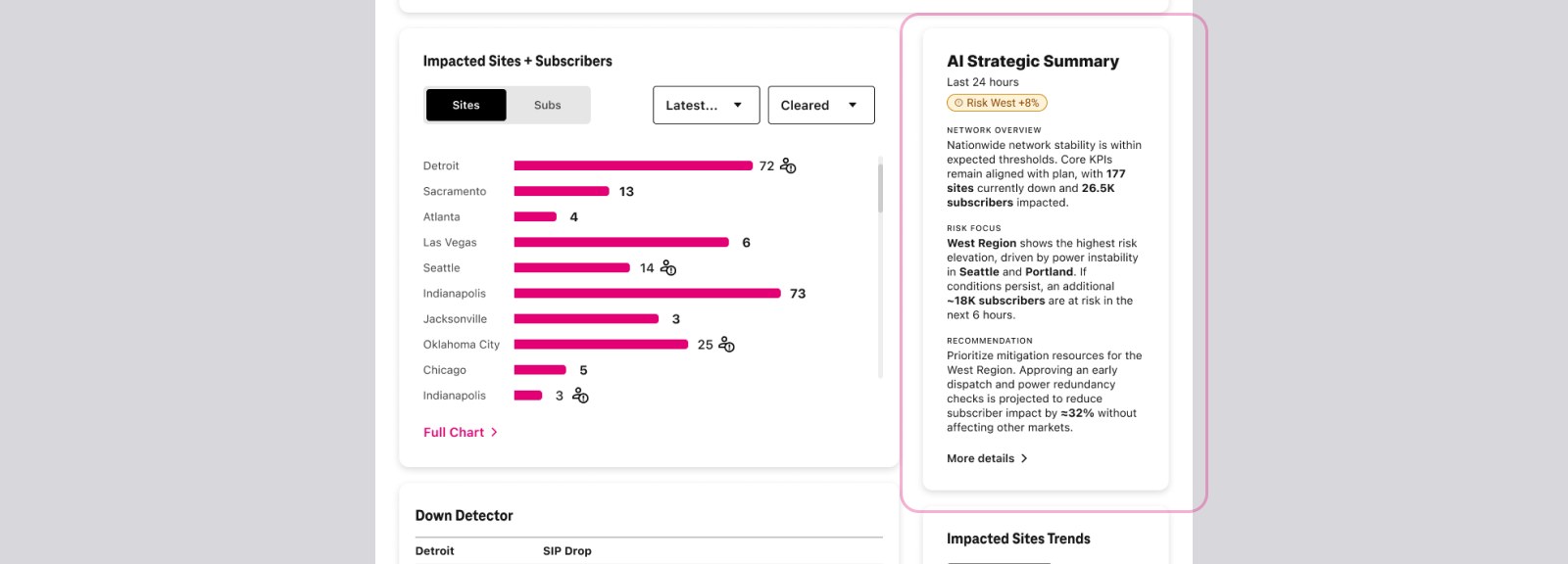
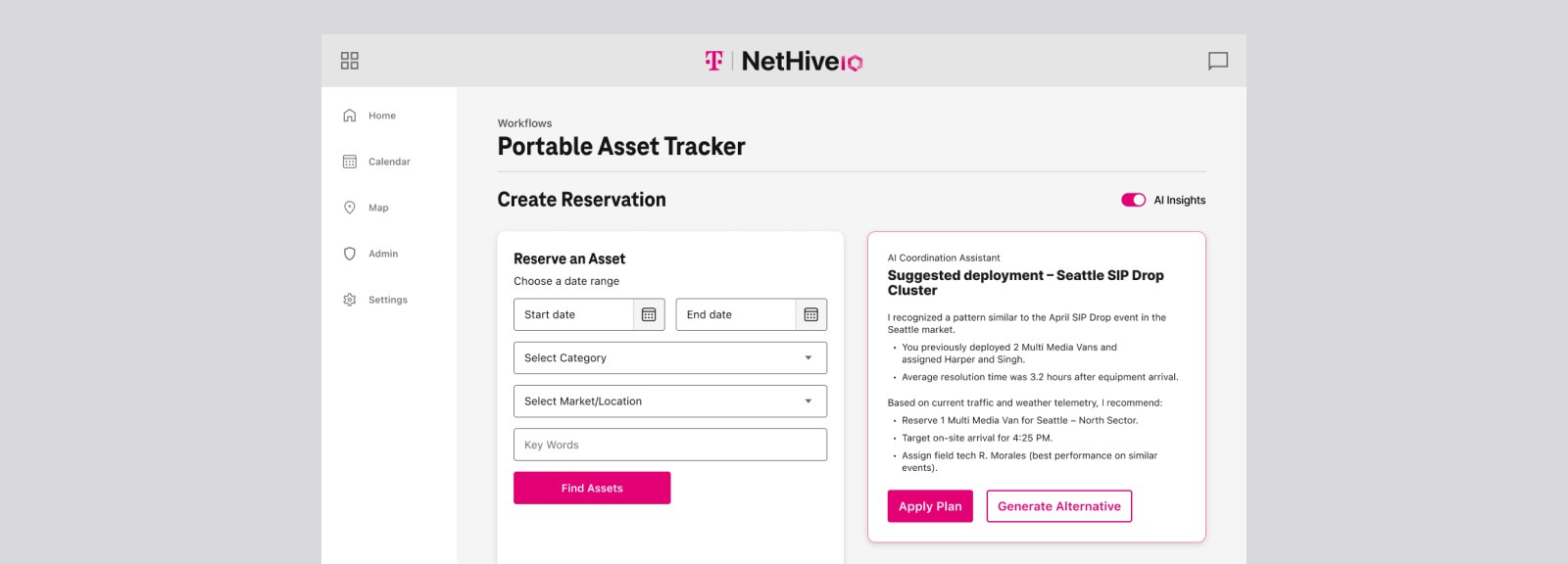
Three implementation scenarios show the system holding together — same underlying AI, same XAI standards, completely different experience of talking to it.
Network Executive
Operations Team
Field Engineer

06 · What shipped
A living reference, not a one-time deck.
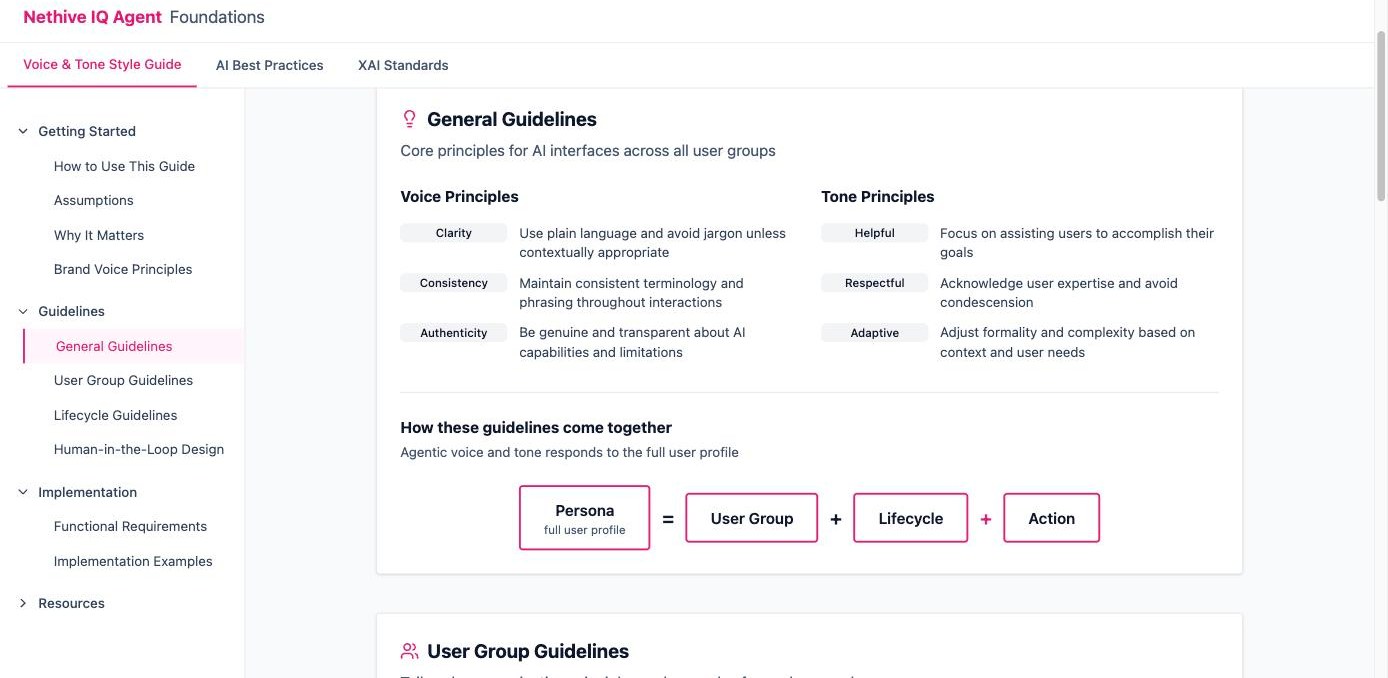
The output is the NetHive IQ Agent Foundations guide — a Voice & Tone Style Guide, AI Best Practices, and XAI Standards, built as one interactive reference for product owners, engineers, designers, and QA to work from together, not three documents that drift apart.
Why it’s worth the overhead
Trust drives adoption
Teams act on recommendations they can verify.
Better decisions
Explanations let users apply context AI can’t infer.
Safer operations
Designed human-in-the-loop moments prevent high-stakes auto-action.
Consistency at scale
Shared patterns across products, not one-off implementations.